The essence of exploration
We live in the 21st century, and pretty much everything has been explored. The only things left to discover are either exceptionally small (like quarks) or exceptionally big (like the edge of the known universe).
Right?
Wrong.
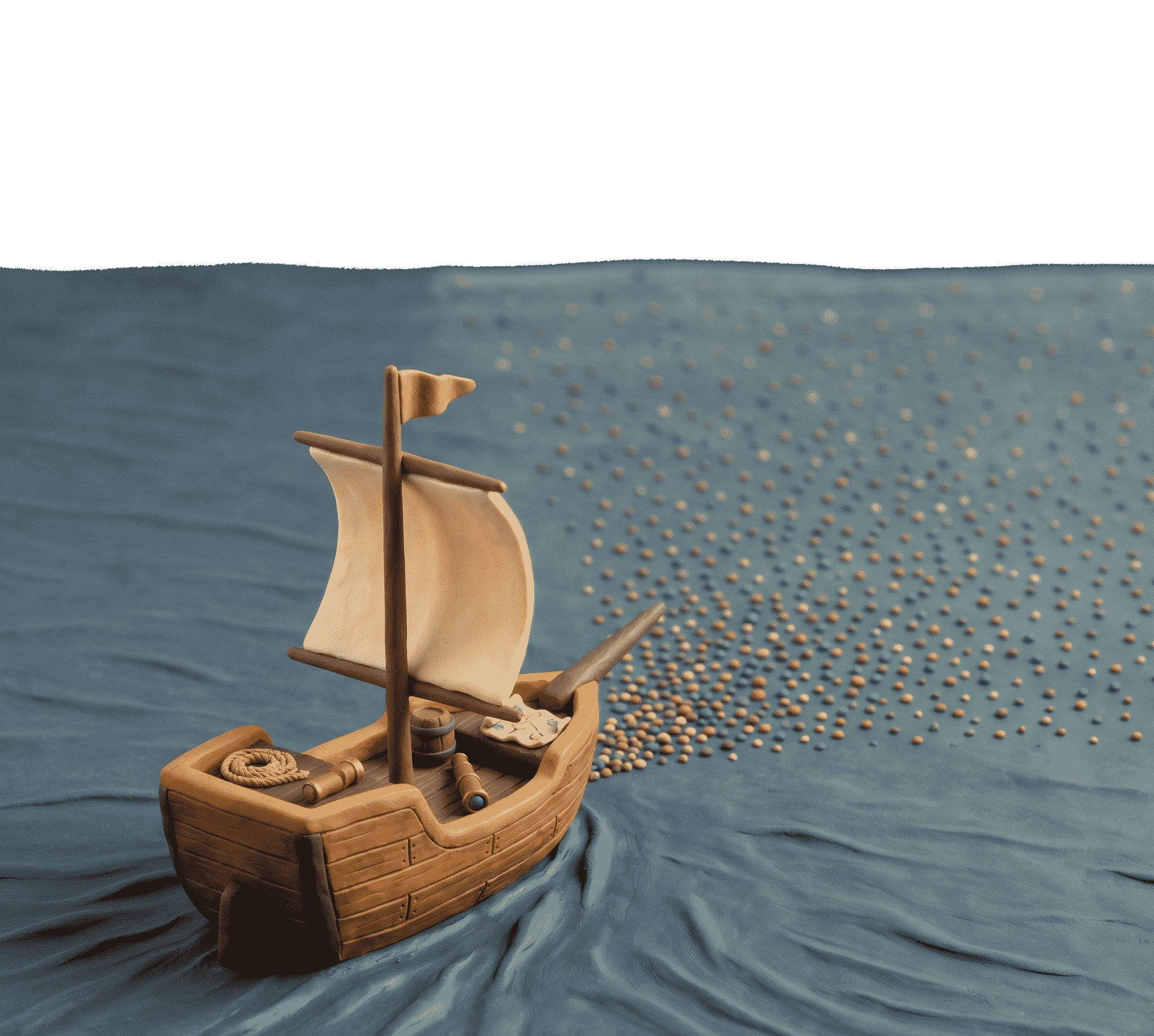
We are immersed in information. There is so much information now available, that it may be impossible for a single human to consume even a meaningful fraction of it in a lifetime. How could anyone claim that something so vast as our present information universe is "discovered?" Ever? We at Playrific believe that not the smallest particle of the known information universe is well explored -- and we believe that generations to come are faced with exploring and mapping it.
This leads to a pretty obvious conclusion: we need to foster a love of exploration in our children.
If we don't, consider how dim our future looks. We will be frozen in time like never before. A new "dark age" of stifled human advancement. It is not so outlandish. Two very enticing urges nail us to the known shoreline of our modest present knowledge. First, we can easily become intimidated by the pure bigness of the challenge. The information "sea" is larger than anything we have a physical analog to map it to. It's bigness is in a category of "Trillion" or "sub-atomic." It's so far outside what we experience that we lack a mental "picture" for it. People become numb. Douglas Hofstadter writes about "Numerosity" in his MetaMagical Themas (an excellent collection of Scientific American articles , compiled into one book). "Numerosity" simply means that people cannot relate to even the magnitude of a number, never mind the actual implications of it. Consider the difference between a million and a trillion. What mental picture do you have for each? Do some searching about and you might find it interesting that your concept of the magnitude of one million bricks and one trillion bricks is way off. That kind of numbness can be intimidating (because it's unknown, and unknown is scary). How bad would things be if we raised children that mentally froze when they encountered the sheer bigness of the information before them?
The second possible enemy is comfort. It is easy to imagine that we have a comfortable grasp on the information we have mastered. Being smug about what you already know (especially because many might consider you an "expert" in a particular field is pernicious in the extreme. And "pernicious" means deadly. Consider that the average first year college student will spend two years learning material that will be completely obsolete by the time they graduate. Now consider whether you have covered that much intellectual ground in the past two years of being an "expert" at whatever you are an expert at. Becoming an explorer means becoming intellectually honest with yourself (and others) that (a) by volume, you know less and less each day, compared to the overall quantity of available information in your field, and (b) that's okay.
We have to help our kids over these two hurdles. First, that there is a mind-numbing amount of information out there, and that's okay. And second, that they will never achieve anything close to a complete mastery of a field, and that's okay, too.
Exploration is the key. And nurturing kids to be explorers is fundamental to our survival.