
Pegs and Holes

"You can't put a square peg in a round hole."
I don't know who originally said that. But, I do know that three separate, reasonably intelligent people have told me that this week. Each treated it as a universal axiom.
However, I offer the following for your consideration.
- Trigonometry
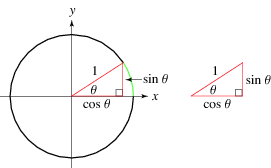
Let x be an angle measured counterclockwise from the x-axis along an arc of the unit circle.
sin (x
) = opposite / hypotenuse.In the case of a right triangle, then the length of the hypotenuse is expressed as:
hypotenuse = opposite / sin (x).
- Our goal
Assume that we express the diameter of a circle as:
d = 2r.
In the instant case, our goal is to restrict the hypotenuse of the square to less than the opening provided in the round (presumably circular) hole:
2r > hypotenuse,
or
2r > opposite / sin(x).
Solving for opposite, which is also the dimension of each side of the square:
opposite <= 2r(sin(x)).
Adding the simplifying assumption that in a square, x must be 45deg, we obtain:
opposite < 2r (0.85090352453),
or
opposite < 1.70180704907(r).
- Conclusion
Thus it is demonstrated that a square peg may pass through a round hole, provided that each side of the square is less than 1.7 times the radius of the hole. QED.