CP - Proposed Solution (Architecture)
At the onset, I note that making the OOB (Out of Box) experience clean and error-free is paramount. Those reviewing this will have very limited time to test and use the solution. Thus, it must operate immediately, with the smallest reliance on external variables possible.
For this reason, I propose to have the solution run on a "known" box, under controlled conditions. This will serve to demonstrate that the solution works as designed. Additionally, the source code and jar is provided, for those who wish to run it locally, on their own system.
The architecture of the proposed solution is a simple LAMP (Linux, Apache2, Mysql, and Perl -- not PHP). Alongside this is a Rails4 stack, running on the same Apache2 instance. The Rails4 system handles the prototype UI only.
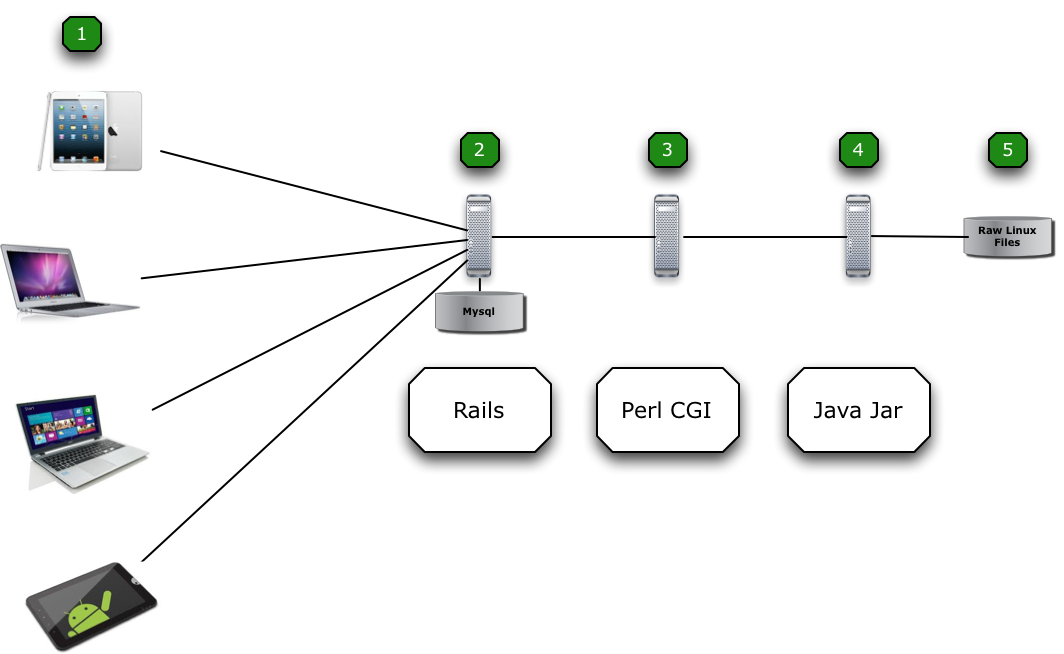
The figure above is meant to be conceptual only, not the actual network path. In reality, all three instances (Rails, Perl CGI, and Java) operate on the same physical hardware.
Starting with (1) the solution must address both mobile and desktop screen sizes. The reviewer may test the solution on a phone, or on a desktop, and the experience must be acceptable in either environment. For this reason, the UI system is "responsive," based on Foundation. Foundation itself uses graphics from FontAwesome, which are acceptable visually at many resolutions.
Though it appears to be overkill, the UI is placed inside a Rails4 server (2). Putting the UI into this framework has advantage of organizing the code into modular files through the HTML template system included in Rails. Rails requires a small database, which in this case is largely ignored.
The UI is partly HTML, but relies heavily on Javascript. Using object-style programming techniques in Javascript, I propose three main objects: Reader.js, Writer.js, and Api.js.
The javascript in the browser needs to communicate with a CGI gateway. (3) I have chosen to create the gateway in raw Perl inside Apache2. The gateway code has a very simple purpose: receive AJAX calls from the browser, and launch the Java as a proxy. It then returns the resulting output as an array of strings in JSON format. This technique was used to minimize UI updating. When the AJAX call returns, instead of re-displaying the entire log, it only updates the lines which are not already displayed. This eliminates annoying screen flashes. It also enables us to control automatic scrolling. If the user scrolls "back" in the log to review text off the screen, the updater adds new information to the bottom of the textarea, but does not auto-scroll the box. This avoids the annoying refresh => "re-scroll to what I want" problem on the UI. There are three files here: Util.pm, _read-v1.cgi, _write-v1.cgi.
Finally, there is the actual Java code, which answers the Statement of Problem. (4) This is self-enclosed in a directory within the Apache2 site. For security reasons, it could be moved outside, to a directory which isn't part of the Apache2 system at all. The Java code is packaged in a single ".jar" file, and the launch format is shown above in the Perl libraries.
/usr/bin/java -cp ../jar/commit.jar com.happytrout.commit.main.WriterCmd -fname=<LOG_FNAME> -cid=<CID> -msg=<MESSAGE>/usr/bin/java -cp ../jar/commit.jar com.happytrout.commit.main.ReaderCmd -fname=<LOG_FNAME> -cid=<CID>